This picture was taken on the opening day of BART's San Francisco Airport extension. Fares were free for the first day, so that means this ticket machine had never actually been used in service.
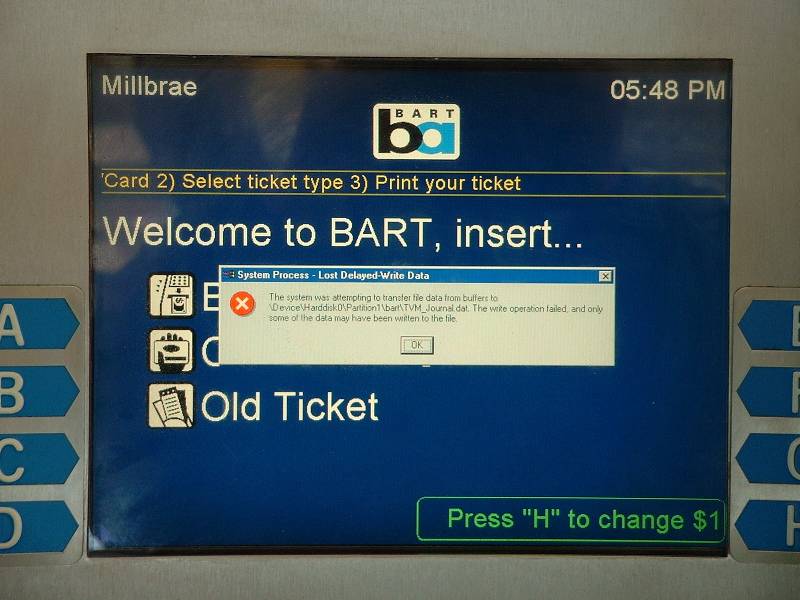
This picture was taken on the opening day of BART's San Francisco Airport extension. Fares were free for the first day, so that means this ticket machine had never actually been used in service.
Remember finger? Ah, the old days of the Internet. "finger user@domain" was a little like a personal home page, before the World Wide Web was invented. This is what you would get if you fingered me, if any of the machines I used ran a finger daemon these days (which they don't). Although now that Mac OS X is Unix, you can finger me if you're logged onto my Mac.
Sometimes I miss the Internet the way it was in 1988-1993, before "the eternal September." When I first worked for ClariNet I had to explain what the Internet was to my grandmother. Five years later she sent me an email. I guess that's a good thing overall, but still, I miss the days when the Internet was a new way of allowing people to access information they were never able to access before, rather than a new way of trying to exploit venture capitalists with more money than they know what to do with.
I used to like the idea of "Internet years" (like dog years, only one real year equals twelve Internet years) until I realized it made me 144 years old. (Even more by now, of course.)
On the other hand, I've always had a deeply ambivalent attitude towards fascination with computers and other technological interests. I never really fit into the crowd on that. (My "geek code block" perhaps embodies this ambivalence.)
I don't know why this introduction is longer than the "finger" results it introduces.
Login: aaron             Name: Aaron Priven
Directory: /Users/aaron              Shell: /bin/tcsh
On since Tue Dec 17 12:40 (PST) on console, idle 7:04 (messages off)
On since Tue Dec 17 18:20 (PST) on ttyp1
Plan:
Sure, I have a .plan, but do I have an .environmental-impact-report
and an .alternatives-analysis?

-----BEGIN GEEK CODE BLOCK-----
Version: 3.1
G! !G
------END GEEK CODE BLOCK------
I am phasing out my old domain, chrysopylae.com, in favor of my new one, priven.sf.ca.us. This is a belated recognition that
In the long run, this change will pay for itself, and I have commemorated this event with a new verse for a well-known spiritual:
No more InterNIC money from me,
No more, no more,
No more InterNIC money from me.
Fifty dollars gone.
Chrysopylae.com has now been deleted.
And yes, I live in Oakland now, but actually I lived in San Jose when I first got priven.sf.ca.us. It doesn't matter -- the document describing the .us domain clearly states that the domain for the central city of a region can be used for surrounding cities. The WELL, located in Sausalito, was well.sf.ca.us for years before deciding to get a .com domain. Anyway, it was a big pain changing from chrysopylae.com to priven.sf.ca.us and I'm not going to do it again.
New as of February 2000: With competition in the registry business, prices have gone down significantly. So I went ahead and reregistered chrysopylae.com and decided I'd get priven.com too while I was at it. Now www.priven.com and www.chrysopylae.com both point to this site. Eventually I will probably phase out priven.sf.ca.us in favor of priven.com, although they will all work.
Chrysopylae means "Golden Gate" in Greek. John C. Frémont, who first named the Golden Gate (before that it was called "La Boca," or "The Mouth" of the bay) originally referred to it as "Chrysopylae." He was making a reference to the Chrysoceros, the Golden Horn, a waterway in Constantinople. San Francisco, like Constantinople, was supposed to be a gateway to the Orient.
I thought an obscure bit of California history would be a good name for my domain, but in practice it just meant that I had to spell it a lot.
I never really liked this very much -- it doesn't really do much besides change the original song to the Internet milieu -- but what the heck.
This is a parody of the original song by Woody Guthrie. It is the song that (as of December 2003) the Postal Service is using for its ads. (Without checking I'm not sure, but it sounds like it's John McCutcheon's version from his album also called "Mail Myself to You." Hooray for the Apple Music Store for letting me listen to 30 seconds of this for free.) This parody (especially the spoken part) is based on Pete Seeger's version on his "We Shall Overcome" concert album.
I'm gonna wrap myself in IP
I'm gonna use TCP too
Four octets on the top of my head
Gonna e-mail myself to you.
I'm gonna tie me up with SMTP
I'm gonna use sendmail too
Climb up inside my hard drive
Gonna e-mail myself to you.
(spoken)
And then my modem comes and takes me out of the hard drive and breaks me up into little packets and takes me down to my ISP. And they put me on a big T1 in a big ATM network. And then it gets to your ISP and they take the packets and throw them off the T1 and they take me down to their port selector and your modem comes and takes me down the POTS line to your house.
When you find me in your e-mail
Double-click and let me out
Get those header lines offa my fingers
Wash that spam taste outta my mouth.
Take me out of my IP wrapper
Wash the octets offa my head
Fill me up with steaming lattes
Stay up geeking out of bed.
I'm gonna wrap myself in IP
I'm gonna use TCP too
Four octets on the top of my head
Gonna e-mail myself to you.
Someone asked me to write a story -- so I used what was handy as inspiration.
Once upon a time there was a country called Desktop where lots of little icons lived. On one part of Desktop lived "Hard Disk" and "Zip Drive" and little "Floppy Drive." On another part lived the Alias family: Photoshop Alias, PageMaker Alias, and ClarisWorks Alias. Finally, down in the underside of Desktop, lived a monster icon known as Trash. The other icons stayed away from Trash!
Every icon on Desktop lived in the hope, and the fear, that one day the Great Pointer would come and select it. Two things could happen when an icon was selected by the Great Pointer. It could be opened. What a glorious thing being opened was! Instead of being cramped up into that little icon, like a butterfly coming out of its chrysalis, the icon would open up and become a Window! It would be able to spread itself out over a great deal of Desktop. What a stretch! What a joy! Have you ever had to sit in a cramped car for hours and hours -- and didn't it feel good when you could get out and stretch your legs? It was like that, only much, much better. And each window was able to do work for Great Pointer. Each created its own little documents for Great Pointer, and got a fair number of computer cycles in return.
Some icons got to open up and be windows pretty regularly, like Hard Disk -- but others, like Script Editor Alias, had never gotten opened up at all.
The other thing that could happen when an icon was selected was that it could be chosen to be a Sacrifice. A Sacrifice to the Trash. Nobody knew what happened to an icon when it was put in the Trash, but everybody remembered some of the older icons -- like SuperPaint and MacWrite -- had gotten eaten by the Trash and were never seen again.
One day a new icon visited Desktop. It was called "Microsoft Office Installation CD." Before the other icons had even had a chance to say hello, it was selected by Great Pointer and opened. Soon enough, the new Installation CD had gone away, but two new icons stayed on Desktop -- Word Alias and Excel Alias.
The other icons tried to be friendly to the new icons, but they wouldn't even say hello. They only talked to each other. "RTF, XLS, OLE, DOC" they said. None of the other icons understood what they were saying. Even PageMaker Alias, the oldest and wisest of the icons, could only barely understand what was being said, and she couldn't make herself understood at all.
Worse yet, Great Pointer almost always chose the new icons to become windows. PageMaker Alias and Photoshop Alias were still used, once in a long while, but ClarisWorks Alias was left to crawl around as an icon.
ClarisWorks Alias decided to call all the other icons in for a meeting. "Is this fair?" asked ClarisWorks. "We've been doing work for Great Pointer for years, and now he just ignores us?" A round of approval came from the older icons -- Photoshop and PageMaker Alias.
But the new icons jeered him -- for the first time, speaking to the older icons. "Oh yeah, little baby Clarisworks can't cut it anymore," said Word Alias. "Why don't you grow up? You can't address envelopes or do fancy layouts like I can. And you can't do fancy formatting like Excel can. Be lucky Great Pointer doesn't throw you away!"
Still, PageMaker and Photoshop supported ClarisWorks, and so did all of the other older icons. It was decided that the next time Great Pointer came, nobody would open up. They knew that they'd lose their computer cycles, that they would be giving up their chance to stretch, and that it might mean trouble. But they knew that if they didn't act together, they'd never be able to stand up to Great Pointer.
Still, they didn't expect it to happen the way it did. The next day, when Great Pointer came, Word told Great Pointer about the meeting. Great Pointer was angry. Great Pointer decided to make an example of ClarisWorks -- and he selected ClarisWorks and took him to the Trash!
All of the older icons were shocked. They were scared. "What happens if it's me next!" they all thought to themselves.
Except PageMaker. PageMaker reared her icon mask, now streaked with grey, and stood up so she could be heard by all Desktop. She said, "I have been an application for nearly fifteen years. I've seen applications come and go. MacDraw, MacPaint, Font/DA Mover, SuperPaint, MacWrite... some of them put in for retraining but they're all gone now. I know that sooner or later it will happen to all of us. The question is, are we going to do something about it? Are we going to cower and wait for the day we get dragged to Trash, or are we going to stand up and fight?"
The other icons looked up at PageMaker. Little Script Editor said, "But Ms. PageMaker Ma'am, what if they throw us... throw us to the Trash?"
PageMaker shouted "Better to be dragged fighting than to slip silently to the garbage heap!"
And with that, a great roar of cheers surrounded PageMaker. All of the icons resolved the next day to quit cooperating with Great Pointer. Except that when they all agreed to sign the pledge, nobody knew where Word and Excel had gone.
The next day, when Great Pointer came, he tried to open Photoshop, but he wouldn't open. Then PageMaker, but she wouldn't open either. Finally he opened Word -- and Word opened and worked like normal.
"Scab!" cried Photoshop. "Scab! Scab!" yelled the other icons. But Word kept working. PageMaker said she knew what to do. She threw her mask back and yelled "System Error -10" -- and threw a bomb!
The next day was full of violence. Great Pointer would open up Word when somebody would throw a bomb! "System Error -10" was the rallying cry of the Great Icon Strike.
After two days of this, Great Pointer agreed to talk with the icons. They agreed that Great Pointer would not throw away any more icons, and that when an icon could no longer be given a higher version, it would be given a nice pension and stored on a removable cartridge. Meanwhile, PageMaker agreed that she would not throw any more bombs, and that all the icons would go back to work. Even ClarisWorks, only a little worse for wear, was pulled out of Trash and allowed to become a window a few more times before being pensioned.
And in the end, everybody lived happily ever after... at least until the Great Pointer moved its operations to a network server in a third world country!
This was originally written for a Sierra Club mailing list in October, 1999.
I'm a little disappointed that the discussion of sprawl and population growth has been so polarized. On the one hand, some people argue that an infinitely growing population is not a problem; on the other, some argue that it is the "key driver of environmental destruction," implying that it is the primary cause of sprawl. Neither is true.
Population growth is an important environmental issue. It's clear that, in general, more people on the planet mean that more resources must be used to support them. More land must be taken from wild use and put toward agricultural use or used for housing. Technological fixes such as the so-called "green revolution" have decreased biodiversity and jeopardized our food supply by making it vulnerable to epidemics. Genetically engineered food plants come with their own sources of danger. So population growth must be recognized as a serious problem, and one that we as Club members should be helping to solve.
On the other hand, we must also recognize not everything bad is the result of population growth. Growing population by itself is not the source of our problem with sprawl. Rust Belt cities that have had shrinking or stable populations still have expanded pell-mell into the countryside. An increasing population is not responsible for the loss of wild and rural land around Buffalo, Providence, and similar cities. We cannot eliminate sprawl simply by limiting population growth.
Does that mean we should accept population growth as a good thing? Not at all. But we may realize that it's easier to guide the floodwaters to a floodplain than to try to put up a dam. We need to have more than one strategy for dealing with growth -- try to stop it, but if we cannot (and we should not pretend we have control over it when we do not), direct it so that it is more sustainable than it would be otherwise.
Sprawl is new construction happening at the fringes of the urbanized area instead of in already developed areas. It's absolutely true that one reason sprawl happens is because population and employment growth require new construction, and new construction is now occurring predominantly at the edge.
But population growth is far from the only thing that causes new construction. There are many reasons that workplaces and housing are taken down in the center and rebuilt at the fringes. Sometimes this is because the buildings are old and dilapidated. Sometimes this is because they occupy space that people wish to use for other purposes. (Parking lots have been a major cause of displacement.) Sometimes they are simply obsolete.
Sprawl is caused by all these changes moving the city outward. Even a city with no population growth will still experience change in its buildings. Stopping sprawl will entail redirecting this development back inward, to already developed areas, instead of out on the fringe.
Somehow the idea that there are better and worse ways to grow got transmuted into the idea that there are good and bad ways to grow -- a small but important distinction. It is still useful to discuss forms of development that are "smart" and those that are "dumb," even if we are trying to reduce growth overall.
The question of sprawl comes down to what kind of cities we should have. Should our cities spread out across the landscape or be limited to compact urban areas?
This question is still valid whether or not there is population growth. Even if there were population *shrinkage*, it would still be a valid question to ask which is more environmentally sustainable: spread-out development or compact development? Population shrinkage would make the question less urgent, as unsustainable activity would have a larger resource base to consume, but no less relevant.
I suppose someone might make a case for a spread-out city as one that's better environmentally, but I haven't heard one yet, and frankly I'd be very skeptical. The case for compact cities is really pretty simple: that "reduce, reuse, recycle" should be applied to land use as well as consumable goods. The more land we build on, the less land is available for wild land and more environmentally friendly uses.
It's been said that we need to live within the carrying capacity of the planet; we need to ensure that we don't exceed the capability of the natural resources to sustain us. This is absolutely true. However, the amount of natural resources we consume is not a fixed amount per person. Someone who does not have a lawn uses a lot less water than someone who does. Someone who lives in a small apartment requires less heat than someone who lives in a large house. Living within our carrying capacity has to be about how we live as well as how many we are.
What about choice?
It's been argued that cities should have the choice whether to be compact or whether they should be spread out. I am always surprised to hear this argument from environmentalists. Normally, environmentalists do not argue that it should be a choice whether to have a citywide recycling program or not, or to log one's own stand of old growth forest, or take other environmentally damaging action. But apparently it's supposed to be OK to choose a spread-out city over a compact city.
We need to recognize that "People should be able to choose" is not an environmentalist argument. It is an argument that ignores our moral responsibility for preserving the natural environment, for its own sake or for the sake of future generations. It might be argued that a difference lies in this choice being made by a community rather than an individual. But, even if this were true (and it is not; decisions on such issues as solid waste disposal are made by cities) our communities do not end at the city limits.
Of course, the arguments have been made many times that in fact our society skews choices towards the outer fringe away from the center. The low supply of new housing, decisions made by our employers, the economies of scale of new developments on the edge, all encourage us to move outward rather than inward, even if that's not what we might otherwise like. When we ask people what they'd like to live in, they often identify kinds of buildings that aren't available given other constraints on their choices. This needs to be rectified.
In practice, building choices are very slow to change. We already have a tremendous amount of sprawl development that has been built since the 1940s. Those who prefer that sort of living will have that choice for a very long time to come. But future developments need to take into account the environmental costs of that choice.
Books have been written, and will no doubt continue to be written, about this issue. I don't think "livability" is something that can be measured. It's a fundamentally subjective feeling that a place is an appropriate one in which to spend time.
It's clear that some people seem to find spread-out suburbs better places to live, and some people compact cities. We're not going to magically bring everyone to agreement on this issue in this forum.
But I think it can be said without fear of contradiction that cities can be good places to live, and millions of people enjoy compact city life and find it a positive experience. The Club's web site at http://www.sierraclub.org/sprawl/community is a good start to explain how some people, at least, believe it to be so.
It is my belief that when an alternative is preferred by many people, and is shown to be more sustainable, it is something environmentalists should be advocating. That isn't to say we should advocate the wholesale return of the suburbs to wild conditions, any more than we have pushed for the elimination of disposable forks and plates, or the elimination of all private forestry. But it does mean that we need to see sprawl as an issue that's not just an individual choice. We need to see living and working in the central city the way we see choosing to use recycled goods -- often just common sense and not necessarily deserving of accolades, but as something that nonetheless is clearly preferable to the alternative, from an environmental perspective.
I suppose somebody, somewhere, must be in favor of compact cities only in order to make transit work. But the linkage between land use and transportation isn't just one way.
A spread-out city doesn't work well with transit because there are not enough origins and destinations close to the transit stops to make them practical. But it's also true that a compact city doesn't work well with cars, because the space required to park the cars is very great. That requires either very expensive parking garages (limiting the ability of the city to build compactly; only those uses that provide a high economic return can afford to ) or the provision of large parking lots (thus making the city less compact).
It's a bit of an oversimplification, but in essence there are two kinds of cities: spread-out car cities and compact transit cities. In practice, we have real spread-out car cities in the suburbs, which have all the environmental problems of sprawl, and a sort of half-way mixed system in most of our central cities, with inadequate transit and many parking lots that end up pushing development further outward and also make the city feel less connected, and thus less livable. This is the result of decades of mistreating our central cities. This is something that needs to end.
Density just means putting more things in less space. Using less land for the same population.
There are real reasons why density has a bad name, but they are not intrinsic to building at a higher density than is typical in sprawl. For example, since density generally requires larger structures, a bad design for a structure has a greater impact, and there are an awful lot of really bad buildings out there: International Style buildings that are alienating and not on a human scale. This really is a matter of design rather than density per se. Many of the Brutalist college campus buildings of the 1950s and 1960s are not particularly dense, but are just as alienating and have an equally negative effect. The answer here is relearning patterns of architecture from prior to Modernism. Architects need to design buildings that fit fit the pattern of street development and not break out of it as an artistic statement.
Another reason density has a bad name is because of the blockage of light. This is one of the main reasons that the "anti-Manhattanization" movement in San Francisco was started. Of course, the very parts of San Francisco that were most negatively affected by shadows cast by buildings from the the '80s building boom are far, far more dense than anything in the suburbs. There is a limit to how high buildings can go without causing shadow problems, of course, and we do need to be careful, but there's a lot of middle ground between the typical suburb and Hong Kong.
Finally, the most common reason one hears to argue against density is because density brings cars, and they bring traffic congestion, noise, and pollution. I shouldn't even need to point out that the cars, not the density, are the problem here.
One day I took my niece, Guadalupe, to another child's birthday party. This is an email exchange between her father and me.
From: Aaron Priven
To: Dan Priven
Date:  January 16, 1999

Hi, Dan.

One of the many things Guadalupe got in her "loot bag" last night was $99
in fake money. While I suppose you might allow Guadalupe to simply spend
this money on fake things, it might be better in the long run to use it to
teach her more about money.

For example, I would be happy to open an account for her at the California
Fake Bank. The bank offers both bankbook savings as well as checking
accounts, both of which bear interest -- 2% for bankbook savings and 1% for
interest checking. Certificates of deposit are also available at
competitive rates for a wide variety of terms, from 60 days to 5 years.
Deposits are fully insured by the Fake Deposit Insurance Corporation (FDIC).

Alternatively, I would be happy to purchase some shares for her on the Fake
Investment Exchange. A number of companies' stock is traded there, from
stable dividend-bearing companies like Fake Gas and Electric (FIX:FGE) to
volatile Internet stocks which might go up in value.

I have not, at the present time, set up a fake options exchange or
derivative trading floor, but if Guadalupe seeks to put her money in these
kinds of instruments, I'd be happy to oblige.

Let me know,

 =Aaron=

From: Dan Priven
To: Aaron Priven
Date: January 19, 1999

     I already sold her 99 fake lotto tickets, but thanks,
     anyway.

        -Dan
(This was written in 1995 or so, except for the last section on things I enjoy, and some minor editing. It's still more or less accurate, although a lot of computer-based communication seems pretty mundane to me these days. It certainly has progressed past Neat Programming Tricks. Now it's gone too far in the other direction, into Neat Marketing Tricks.)
I am one of those people who, it seems, has trouble specializing I have several long-standing areas of interest that I have followed through my life. I could imagine working very hard in any one of these areas.
In high school our journalism class was taught for two years by a ranking editor at the local newspaper. Most people learn little in high school journalism; I learned a lot. Not enough to make the regular column I wrote worth reading at this late date, but a lot nonetheless. (Thanks, Micki, if you're out there.) In college I worked on the business side of one of the college papers for a very short time, and I was one of many undergraduate section leaders for a media-criticism course. I also helped edit the Course Review Book, the student guide to classes at U.C. Santa Cruz.
Until March, 1998, I was Senior Editor for ClariNet Communications Corp., publishers of ClariNews, an "electronic newspaper" on the Internet. I was responsible for the classification of wire service copy into our hundreds of "clari." newsgroups. I also moderated the Usenet newsgroup alt.journalism.moderated for a time.
I strongly believe that the Internet is a tool for communication, and that it is the result of using this tool that is interesting, not the details of the tool itself. Too much of the material on the Internet, and on the WWW for that matter, consists of Neat Programming Tricks, and not of real uses that will matter to people. My favorite Internet site, because it symbolizes this as well as involving my other interests, is the Transit Information Page maintained by a couple of U.C. Berkeley students (in their spare time, yet). These pages are truly useful in a way that very few World Wide Web sites are. They bring information unavailable anywhere else and difficult to provide in earlier media, the entire schedules of most Bay Area transit systems, to thousands of people on the Internet. It's not perfect yet, mainly because of the lack of maps, but there's no reason now for anyone with Internet access to collect the paper schedules still handed out on Bay Area buses.
(This was written long enough ago that the link to the Transit Information Project was originally to the server.berkeley.edu site. How times change -- one of my professional responsibilities now is making sure AC Transit information gets to transitinfo.org)
But it was in 1985 that I really became interested in the subject. Mine was one of the first, if not the first, high school newspaper in the country to be desktop published; it was first produced in September, 1985. (We used Aldus PageMaker version 1, on 512K Macintoshes with 800K floppy disks, and a LaserWriter -- not a LaserWriter Plus.) I was Production Manager for 1986-87. Later I typeset two annual Course Review Books and numerous newsletters for UCSC school papers and assorted non-profit groups. I have only a little formal training in design, but I try to read about it as much as I can. I am to the point where I know what I don't know -- which is quite a lot!
I've been interested in constitutions and political systems since that time. When I was a sophomore in college I took a course on the British political system that really excited me about other constitutions. The British constitution was so very different, so interesting to me, that I wanted to spend time studying a foreign political system up close. I spent my third year in college at the University of British Columbia in Canada as an exchange student. Although English Canada's general culture isn't very different from the U.S., the political system is quite different. It was very interesting to study it up close, at least for a while. I did eventually get burned out on the intricacies of Canadian federalism and the party system. But I still am interested in Canadian politics.
These are all things that are important to me, that I could imagine making a career in. There are, of course, other things that interest me -- diversions, entertainments. Here are some notable ones.
And, of course, there are a lot of other things I like, but which aren't coming to mind right now.
(High school and first-year university students -- don't bother writing me, saying that of course you don't intend to simply copy them for your classes but you'd really like to see the fascinating material I must have written on these subjects. If you're going to cheat, pay the guy down the hall to write it for you. At least that way you'll support the local economy.)
For some reason I've never really been able to figure out, I occasionally rewrite song lyrics. Science-fiction fans call them "filk songs," a term that supposedly arose from a typographical error. Although it does lend one ideas (perhaps an article on "The Filk Process" by Alan Limax?) I've never liked the term very much. It strikes me as self-indulgent.
Or maybe it's just the filk songs themselves that are self-indulgent. Just changing the background of a song from contemporary to futuristic isn't particuarly interesting or amusing. That's not to say one couldn't write an amusing science-fiction parody, but I would hope it would have some point beyond that.
Of course, if the song isn't funny at all, it's not really parody, is it? "Bob Dylan's Dream" was inspired by "Lady Franklin's Lament" and many phrases are the same, but nobody could really call it a parody. [Unlike "Ikea Lament", which was written years after I originally wrote this.]

 Posts
All Comments


